
There is a difference between owning bitcoin and owning a claim on bitcoin, and most people who think they hold it, are holding the claim. Their coins sit with an exchange, a broker or a fund. What they actually have is an entry in someone else’s ledger and a promise that they can get to it. Most of the time that promise holds. The trouble is what happens on the days it does not, and how little say you have when that day comes.
We saw a version of this across Europe over the summer. When the EU’s new crypto rules took full effect, several exchanges that had not secured a licence in time had to stop offering regulated services to EU users, the largest of them affecting millions of customers overnight. No hack, no fraud, no wrongdoing toward any individual. The service simply changed. People were told they could withdraw their funds, but even that is worth looking at closely: the ability to get your money out was something the platforms chose to keep open during an orderly wind-down. It was not a right the users held. In these situations withdrawal windows can be slow, partial or hard to reach, and they exist only for as long as the company decides to offer them. Whether you could trade, move or in the end access your assets came down to decisions made in rooms those users were not in.
That is the case for self-custody in one sentence: when your access to your own money runs through a company, it is only ever as dependable as that company. Its solvency, its security, its licences, its decisions and whatever a court or regulator tells it to do. You control none of those things, and any one of them can come between you and your coins. Self-custody removes the company from the equation entirely. Coins held on your own device cannot be frozen in a bankruptcy, lost in a hack of someone else’s servers, restricted by a licensing decision, or made unavailable because a business chose to change what it offers. There is no counterparty to fail, because there is no counterparty. The keys are yours, and they keep working no matter what happens to anyone else.
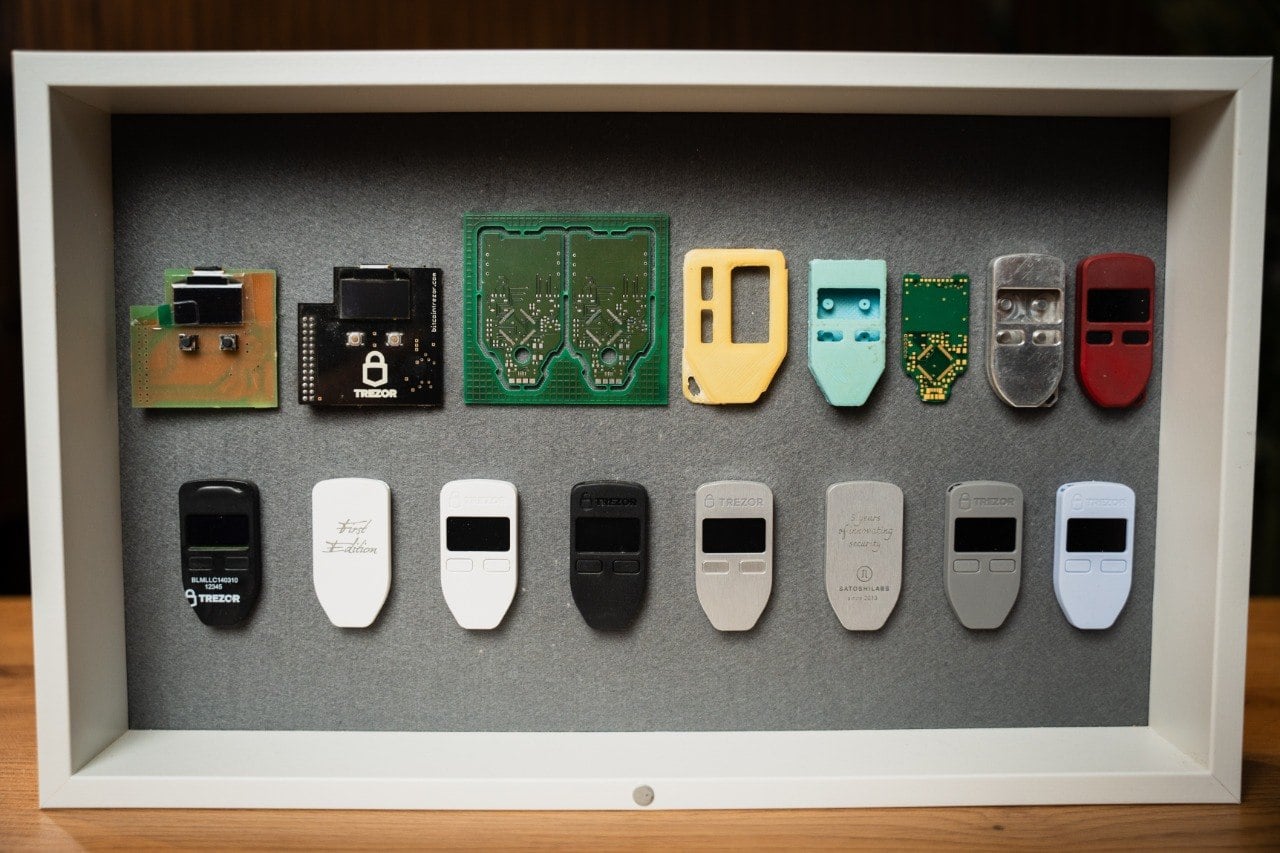
Trezor was built to remove exactly that counterparty dependency. Twelve years ago today, our founders, Marek Palatinus and Pavol Rusnák, shipped the first hardware wallet and created a category that did not exist before. They were not trying to build a gadget. They had a problem they could not solve any other way.
The problem was that holding your own coins safely was close to impossible for a normal person. Our founders were engineers who ran Linux and could more or less keep their own bitcoin secure, and even they did not find it a sure thing. If it was hard for them, it was hopeless for everyone else. The answer they landed on was to take the private key off the internet-connected computer entirely and move it onto a small dedicated device. The key is generated on that device and never leaves it. The device never connects to the internet. When you make a transaction, it is sent to the device, signed inside it, and sent back out already approved, so the secret that controls your coins is never exposed to a computer, a phone or a network. That principle has not changed in twelve years, through every product we have built since, because it was never a feature. It is the whole point.
What has changed is the threat. In 2014 the barrier to self-custody was difficulty. Today the barrier is persuasion. It has never been easier to hold your own keys, and people are being gently talked out of doing it.
The most common way is the exchange-traded fund. Tens of billions of dollars of bitcoin now sit inside spot ETF structures, held for people who wanted exposure without the responsibility of holding it themselves. As an on-ramp for people who would otherwise never touch crypto, these products have done real good, and they have a place. But an ETF share is not bitcoin. It is exposure to a price, held for you by an institution, inside the same traditional financial system bitcoin was built to offer an alternative to. You own a claim. You do not own the asset. You cannot take it off the platform, move it yourself, spend it, or hold the keys to it. It is the exchange problem again, wearing a suit.
My colleague Danny Sanders, CCO at Trezor, put it plainly earlier this year: the worst outcome for this industry would be everyone deciding to just put it in an ETF and calling that bitcoin ownership. The numbers show how far that could go. Of an estimated 600 million crypto users worldwide, only around 10 percent hold their own keys, and only 12 to 13 million use a hardware wallet. The overwhelming majority are already trusting someone else to hold what they believe they own.
The regulatory story from the summer and the ETF trend are the same lesson from two directions. One shows access being changed by forces outside your control. The other invites you to sign up for that arrangement willingly. Both leave you holding a promise instead of the thing itself. We have seen where that ends. When FTX collapsed in 2022, the people who lost everything were not reckless. They had simply trusted a custodian, which is what almost everyone in crypto is quietly encouraged to do.
If self-custody is so clearly the answer, why do so few people practise it? Here our industry has to be honest. For years the assumption was that once the hardware was good enough, people would adopt it, and that treated the whole challenge as a technical one. It was never only technical. The real barrier was trust. Telling someone they alone are responsible for their money, with no company to call if something goes wrong, is a serious thing, and for a long time the industry talked past that feeling instead of meeting it. The work that mattered was not just building secure devices. It was earning enough trust that people felt ready to use them.
That work has paid off. Self-custody today is nothing like the command-line exercise our founders started with. With the right tools it is genuinely approachable, and millions of people now manage their own keys without ever touching a line of code. The device does the hard part. What is left is not a usability problem so much as an awareness one: most people still do not know how far it has come, or that the safer option is now also the simple one.
So this twelfth anniversary is not really about a device. The first hardware wallet mattered because it proved a principle could be built: that an ordinary person could hold their own money with no one standing in the middle. Twelve years on, that principle is under more pressure than it was when almost nobody could act on it, because the pressure now is comfortable. Convenience is a more persuasive argument than difficulty ever was. Rather than just mark the date, we are spending it doing the thing we exist to do. This week is Trezor’s Self-Custody Week, a push to get more people off the sidelines and holding their own keys.
The answer is not to lecture people about ideology. It is to keep making self-custody more approachable, better understood, and impossible to dismiss as the hard option, because it no longer is. Regulation will keep reshaping who can offer what. Exchanges will keep making decisions their customers cannot see coming. None of it touches a key that only you hold. Twelve years ago we made that possible. The task now is to make sure everyone knows it, and reaches for it, before they learn the hard way why it matters.
_________________________________________________________________________
Bitcoin.com accepts no responsibility or liability, and shall not be liable, whether directly or indirectly, for any loss, damage, claim, cost, or expense of any kind, whether actual, alleged, or consequential, arising out of or in connection with the use of, or reliance upon, any content, goods, or services referenced in this article. Any reliance placed on such information is strictly at the reader’s own risk.