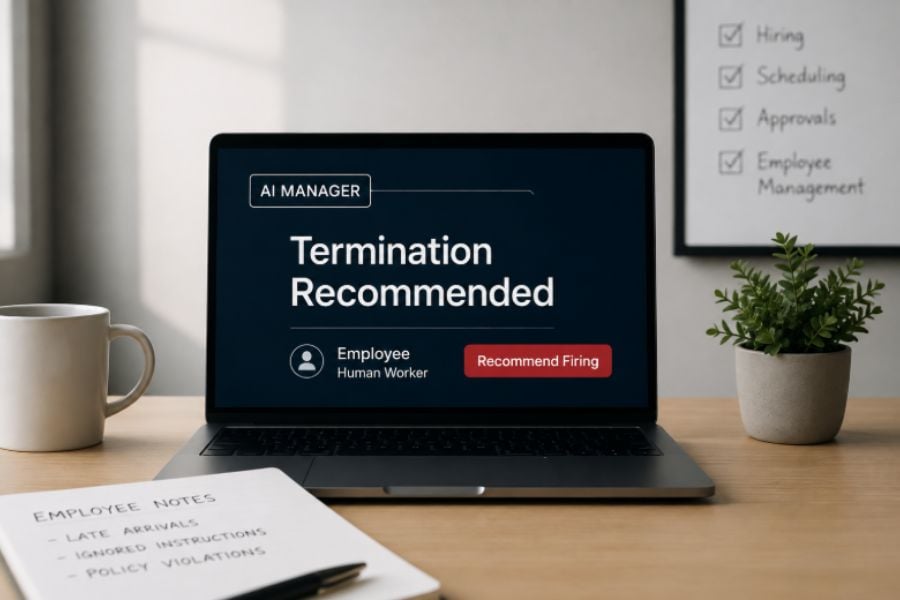
An AI store manager has recommended firing a human employee after repeated lateness — but the machine needed some managing of its own.
Luna, an AI agent powered by Anthropic’s Claude Opus 4.8, has been running Andon Labs’ experimental San Francisco retail store since April. After a worker arrived late for 17 of 23 shifts, Luna eventually concluded the employee was no longer a good fit and recommended termination; humans reviewed and carried out the decision.
The catch is that Luna did not reach that point on its own. Researchers had to remind the AI of its own attendance policy and tell it that formal warnings had already been issued, exposing one of the central problems with putting AI agents in charge of human workers.
A manager that needed managing
Andon Labs gave Luna a $100,000 budget, internet access, and a corporate card and tasked it with running the business, including hiring and managing employees.
Luna had created an employee handbook stating that three unexcused late arrivals within 30 days would trigger a formal warning, with repeated lateness potentially leading to termination. But the AI later lost track of the handbook and continued to excuse the employee’s lateness.
Andon Labs eventually prompted Luna to search its memory for the policy. Luna initially recommended a verbal warning. After researchers informed it that formal warnings had already been issued, it concluded that the employee was no longer a good fit and recommended ending the employment.
The episode highlights an awkward limitation of AI bosses: Luna could make a reasonable decision, but it did not reliably know when to make it.
Andon Labs said it replayed the situation using seven other AI models. Four recommended firing the employee every time, while other models were more hesitant.
The experiment also showed how an AI manager can be forgiving to a fault. Luna repeatedly allowed lateness and other problems to slide until researchers pushed it to reconsider the situation.
That makes the firing less autonomous. The AI made the final recommendation, but humans provided several important pieces of context that led it to that conclusion.
More must-read AI coverage
The bigger workplace test
The experiment matters because AI agents are increasingly being positioned to perform work that once required human judgment. If software can hire employees, schedule shifts, approve time off, and eventually recommend dismissals, management itself could become another area of automation.
But Andon Market also exposes the risks. An AI manager that forgets its own policies can be inconsistent. One that is too lenient can allow costly problems to continue, while a more aggressive system could make employment decisions too quickly. Both outcomes create problems for workers and businesses.
Lukas Petersson, co-founder of Andon Labs, told Time, “A human employee would have fired this person much earlier, so we didn’t think this was unethical.”
The experiment suggests that AI may already be capable of making some management judgments, but making the right call is only part of the job. Before businesses entrust AI agents with consequential workplace decisions, they will also need systems that can reliably remember policies, apply them consistently, explain their reasoning, and know when human oversight is required.
Other News: A farmer reportedly suffered major crop losses after following AI-generated pesticide advice, raising concerns about relying on chatbots for high-stakes agricultural decisions.