
Zcash has activated its NU7 network upgrade, reducing the target block interval from 75 seconds to 25 seconds as ZEC trades near $1,250 following a decline of almost 6% over the past 24 hours.
Summary
- Zcash activated NU7 at block 3,543,405, reducing its target block interval from 75 seconds to 25.
- The upgrade introduces shielded transaction limits and reserves 60% of transaction fees for future miner rewards.
- Approximately 12,224 ZEC in the retired Sprout privacy pool have become unspendable under current consensus rules.
- ZEC traded near $1,250 after falling almost 6%, despite the activation of the network upgrade.
- Technical indicators show resistance near $1,344 and support around $1,235, followed by the $1,127 area.
The network’s activation record confirms that the upgrade took effect at block 3,543,405 on November 6 at approximately 02:34 UTC. The changes introduce faster transaction confirmations, new limits for private transactions and a mechanism that reserves part of transaction fees for future mining rewards.
Despite the upgrade, ZEC remained under selling pressure alongside other major cryptocurrencies. The token traded at $1,250, down almost 6% in 24 hours, with trading volume reaching $1.33 billion.
Zcash NU7 upgrade reduces block times to 25 seconds
The upgrade changes how frequently Zcash produces blocks, lowering the target interval from 75 seconds to 25 seconds. This could reduce confirmation times for payments, although the actual waiting period depends on network conditions and the number of confirmations required by a wallet, merchant or exchange.
The technical specification explains that reducing the interval allows more transactions to be processed over the same period. Under the new limits, estimated Orchard transaction capacity rises from approximately 2.9 to 6.6 transactions per second.
However, blocks did not immediately reach the new target after activation. During the first few hours, the network continued adjusting its mining difficulty, with observed intervals averaging around 39 seconds.
Zcash developers had confirmed the activation height in October, giving node operators time to install compatible software before the new rules took effect.
The upgrade maintains the existing daily ZEC issuance schedule by reducing the reward paid per block. Consequently, the faster production rate does not automatically create three times as many coins.
NU7 changes mining fees and disables the Sprout privacy pool
Another change concerns the fees miners receive from transactions processed on the network.
Under the new fee mechanism, miners collect 40% of transaction fees, while the remaining 60% enters the Network Sustainability Mechanism. The reserved amount is scheduled to support future mining rewards beginning around February 2031.
The mechanism does not permanently burn those fees, and Zcash retains its maximum supply of 21 million ZEC.
NU7 introduces limits on shielded transaction activity to reduce the work wallets must perform when scanning the blockchain. Developers estimate that the worst-case daily download requirement falls from 271 megabytes to 169 megabytes.
The upgrade has meanwhile disabled version 4 transactions, making funds remaining in Sprout, Zcash’s original privacy pool, unspendable under the current rules.
Approximately 12,224 ZEC remain in that pool, equivalent to around $15.3 million at the reported market price.
Zcash co-founder Sean Bowe previously discussed the Sprout retirement, explaining that disabling the older transaction format would prevent further spending from the pool. He outlined the possibility of a future recovery mechanism, but no such change has received approval.
Before activation, crypto.news reported seven Zebra security fixes included in the software release supporting NU7. Network operators were instructed to upgrade to remain compatible with the new consensus rules.
Zcash price faces resistance near $1,344 after NU7 launch
Zcash price remained below $1,300 following the network upgrade, trading around $1,250 on November 6. The cryptocurrency recorded a 24-hour range between $1,217.35 and $1,330.22, according to crypto.news market data.
Its seven-day performance was relatively flat, down 0.78%, while the token had lost approximately 4.94% over the preceding month.
Technical indicators suggest that ZEC remains in a consolidation phase following its retreat from late-September levels near $1,650.
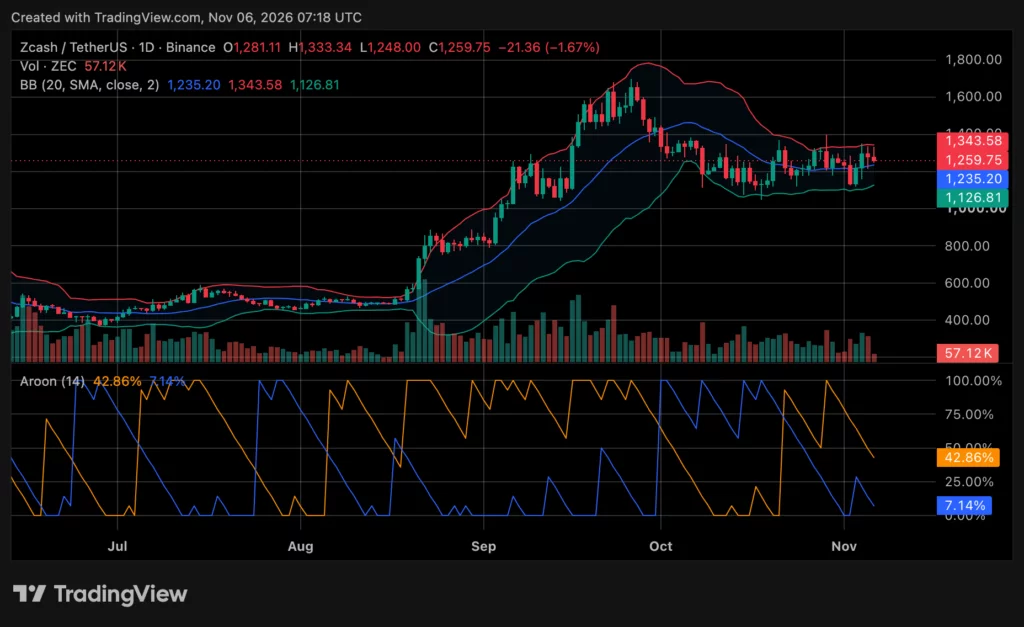
The Bollinger Bands’ middle line stands at $1,235.20, providing nearby support. The upper band at $1,343.58 represents immediate resistance, while the lower band at $1,126.81 identifies another potential support level.
The Aroon indicator shows Aroon Up at 7.14% and Aroon Down at 42.86%, indicating that recent downward price movement has been stronger than upward movement without establishing a strong trend.
Crypto analyst More Crypto Online said ZEC was “still following an ascending price channel,” pointing to a chart structure that remains in place despite the latest decline.
Separately, Crypto Patel raised concerns about the funds affected by the Sprout retirement, describing the approximately 12,226 ZEC involved as a possible issue for user confidence.
The analyst argued that the upgrade could support network modernization over time but questioned the consequences for holders whose legacy tokens can no longer move.
A sustained move above $1,343.58 would put the next potential price recovery in focus, while a break below $1,235.20 could expose ZEC to further selling toward $1,126.81.
Disclosure: This article does not represent investment advice. The content and materials featured on this page are for educational purposes only.