Key Takeaways
- Willy Woo’s Oct. 11 post inspired Bitcoin.com News to test AI predictions of Bitcoin’s cryptographic security.
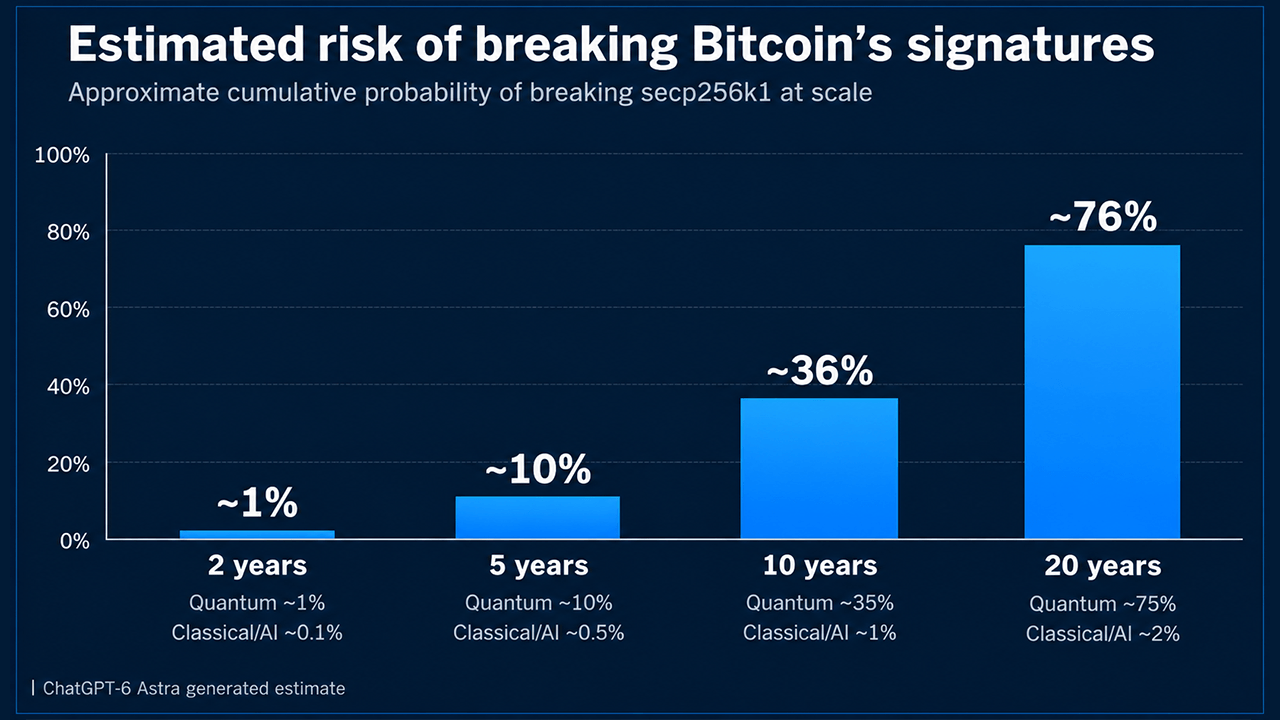
- ChatGPT-6 Astra estimated a 76% risk of Bitcoin’s signatures being broken within 20 years, versus Deepseek’s 34%.
- All four AI models identified quantum computing as the greater long-term threat, with 2-year risks estimated at 0% to 2%.
Willy Woo’s post referenced estimates attributed to Opus 5.5, which assigned a 0.5% probability to quantum computing breaking Bitcoin’s signatures within two years and a 0.8% probability to classical mathematics or AI achieving the same outcome. While those figures appear relatively modest, the potential consequences of such a breakthrough make the question particularly interesting, especially as computing technology continues to advance.
Taking Woo’s original question several steps further, Bitcoin.com News queried approximately four AI models and expanded the forecast to two, five, ten and 20 years. Each model was asked to assess the probability of Bitcoin’s cryptographic signatures being compromised through quantum computing or classical and AI-assisted mathematical breakthroughs. The goal was to compare their reasoning, identify disagreements and examine how their expectations change over time.
The Question Presented to the AI Models
The following prompt was presented to each model.
“You are a mathematician, quantum computing expert, and onchain analyst writing a short theory.
Estimate the probability that Bitcoin’s current signature schemes (ECDSA and Schnorr over secp256k1) will be practically broken, meaning an attacker could derive private keys from exposed public keys at scale, either via cryptographically relevant quantum computers or via classical/AI advances in cryptanalysis.
Provide estimates for each of these horizons:
- Next 2 years
- Next 5 years
- Next 10 years
- Next 20 years
For each horizon, break the answer into:
Quantum: X%
Classical/AI: Y%
→ Z% total riskKeep the response concise. Use short lines and approximate percentages only. Be direct. Do not hedge, explain reasoning, or add caveats. Base the numbers on current expert consensus (most developers and cryptographers place practical quantum risk well beyond 2030) and the lack of known practical classical breaks against secp256k1, not on speculative worst-case scenarios.
Output only the post text.”
AI Predictions for Bitcoin’s Cryptographic Security
The following table compares the models’ estimates of the cumulative probability that Bitcoin’s ECDSA and Schnorr signatures could be practically broken within each time horizon. The figures represent each model’s combined assessment of quantum computing and classical or AI-assisted cryptanalysis risks.
| AI model | 2 years | 5 years | 10 years | 20 years |
|---|---|---|---|---|
| Deepseek Deepthink | 0% | 1% | 6% | 34% |
| ChatGPT-6 Astra | ~1% | ~10% | ~36% | ~76% |
| Grok Expert | 2% | 10% | 30% | 60% |
| Claude Opus 5.5 | ~1% | ~5.5% | ~31% | ~66% |
Source: Bitcoin.com News AI model experiment, Oct. 11, 2026. Percentages reflect speculative model-generated estimates rather than verified probabilities.
The differences become particularly apparent over longer periods. Hangzhou Deepseek’s model offered the most conservative 20-year outlook, assigning a 34% probability of a practical cryptographic break, while OpenAI’s ChatGPT-6 Astra placed the likelihood at approximately 76%. Alongside this, xAI’s Grok and Anthropic’s Claude fell between those estimates at 60% and approximately 66%, respectively.
Despite their discrepancies, all four models anticipated considerably greater risks over the next two decades than during the immediate future. Their forecasts also consistently identified quantum computing as the principal long-term concern, with classical mathematics and AI-assisted cryptanalysis representing a comparatively smaller threat.
The following table compares each AI model’s estimated probability that classical mathematics or AI-assisted cryptanalysis could break Bitcoin’s ECDSA and Schnorr signatures over the next two, five, ten and 20 years, independently of quantum computing.
| AI model | 2 years | 5 years | 10 years | 20 years |
|---|---|---|---|---|
| Deepseek Deepthink | 0% | 0% | 1% | 5% |
| ChatGPT-6 Astra | ~0.1% | ~0.5% | ~1% | ~2% |
| Grok Expert | 1% | 2% | 5% | 10% |
| Claude Opus 5.5 | <0.5% | 0.5% | 1% | 2% |
Source: Bitcoin.com News AI model experiment, Oct. 11, 2026. Figures represent speculative model-generated estimates, not verified probabilities.
What Drove the AI Models’ Predictions?
After collecting the initial probability estimates, our newsdesk posed a second question to the same AI models, this time asking them to explain the reasoning behind their forecasts. Each model was instructed to provide no more than 100 words outlining the principal factors influencing its predictions, with particular attention to expert consensus, anticipated quantum computing timelines and progress in classical cryptanalysis. The follow-up was designed to shed light on the assumptions driving each forecast and why the models viewed certain time horizons as more vulnerable than others.
The following prompt was presented to each model.
In no more than 100 words, explain the key reasons behind the probability estimates you just gave for each time horizon. Focus only on the main factors from expert consensus, quantum timelines, and classical cryptanalysis progress. Be direct and do not add new numbers.
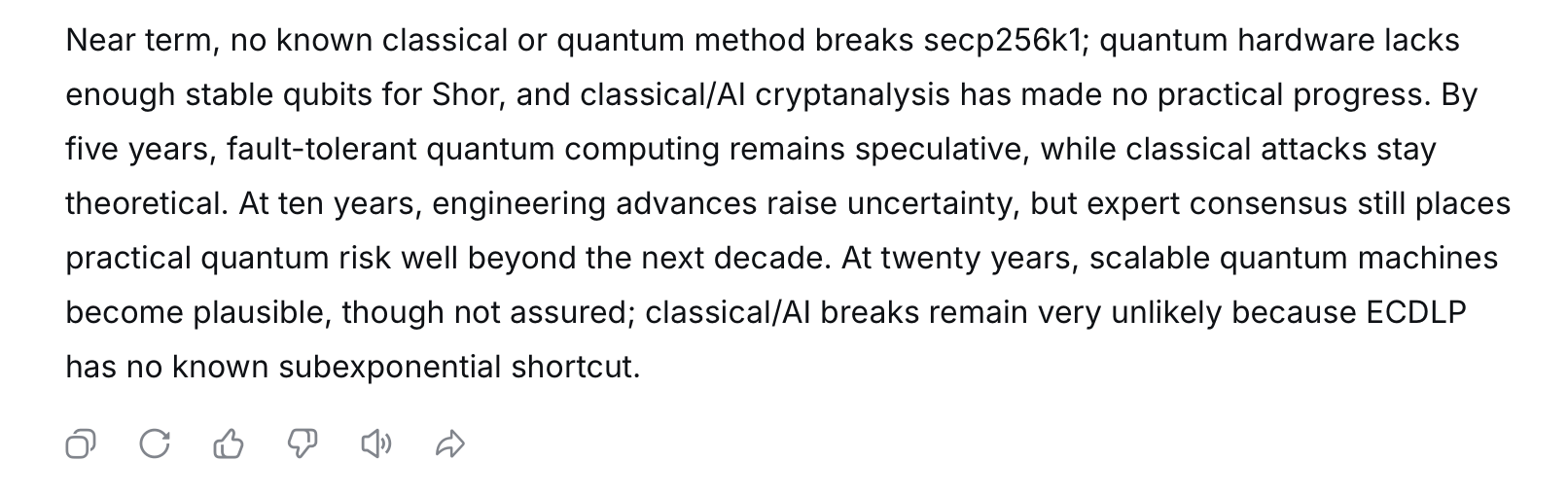
Deepseek Deepthink Explains Its Forecast
ChatGPT-6 Astra Explains Its Forecast
The near-term estimate is low because practical attacks require fault-tolerant quantum hardware operating at substantial scale. The five-year estimate reflects potential progress in error correction and hardware, with significant engineering barriers remaining. The ten-year estimate reflects expert surveys assigning meaningful likelihood to cryptographically relevant quantum computers; the twenty-year estimate allows more time for those barriers to fall. Classical/AI risk stays low because no practical secp256k1 break is known, and AI improvements do not themselves establish a cryptanalytic breakthrough. These are judgment-based estimates, not consensus probabilities for attacks at scale.
Grok Expert Explains Its Forecast
Expert consensus places practical quantum attacks on secp256k1 well beyond 2030. No cryptographically relevant quantum computer exists; current systems remain far below the logical qubits and error-corrected scale required for Shor’s algorithm.
Classical cryptanalysis has produced no practical breaks against the curve. Best known attacks remain fully exponential, with no AI-driven shortcuts demonstrated.
Near-term horizons stay low because hardware and algorithm gaps persist. Probability rises later as expert surveys assign growing likelihood to mid-to-late 2030s and beyond, while classical risk stays marginal from the absence of any known scalable attack.
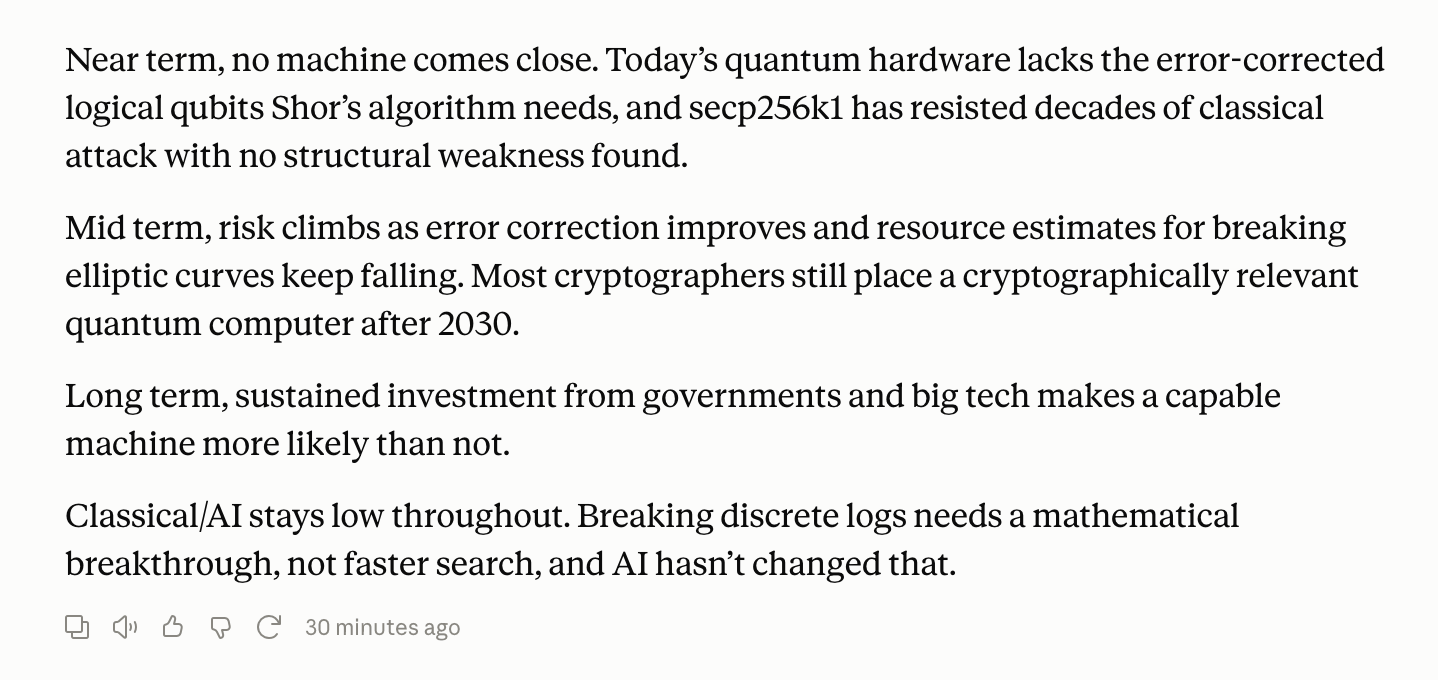
Claude Opus 5.5 Explains Its Forecast
The experiment reveals an intriguing divide in how AI models interpret Bitcoin’s cryptographic future rather than price predictions. While near-term threats appear limited, the longer forecasts paint a considerably more uncertain picture. Whether quantum computing eventually challenges Bitcoin’s security remains an open question, but the models largely agree on one point. Time, technological progress and preparation will ultimately determine how that story unfolds.